
Guide
WoW Forever Legacy system: challenges earn account-wide points, each character spends up to 16 in three trees, and 65 are earnable at launch — the full published rulebook
Blizzard designed the WoW Forever Legacy system to reward a habit it saw in Hardcore: 'seeing so many players constantly leveling and making the world feel active, lively, and full of possibility'. The goal, in its words, was 'to capture more of that energy in a way that rewards players for beginning the journey again without asking them to face Hardcore's deadly consequences' — a system 'designed to make leveling alternate characters (alts) more exciting, emphasize the journey over the destination, and give players new challenges that reward progress across all their characters'.
Here is every rule Blizzard has published, with its numbers, and the questions it left. Nothing below comes from anywhere but the Deep Dive recap of 13 September 2026; where that recap is silent, the page says so.
The loop: challenges → points → trees → rewards
'Players earn Legacy Points by completing Legacy Challenges across several categories, with examples including leveling a specific class or reaching a particular skill milestone.' The challenges are meant to 'complement the existing journey, reward the ways players already enjoy adventuring through Azeroth, and add new goals that make each repeat journey feel more meaningful' — 'not meant to force players into strange tasks disconnected from the game'.
'Legacy Points can be spent in Legacy Trees, beginning with Professions, Adventure, and Resourcefulness.' The word 'beginning' matters: Blizzard says the system 'is also built to grow' with 'new challenges, new perks, additional ways to spend points, expanded spending caps, new columns within existing trees, and potentially entirely new trees'. Points not spent still count: 'those additional accomplishments contribute to the Legacy Reward Track, where accumulating points over time unlocks special cosmetic or prestige rewards, such as the Spectral Bear Cub, without providing a competitive gameplay advantage'.
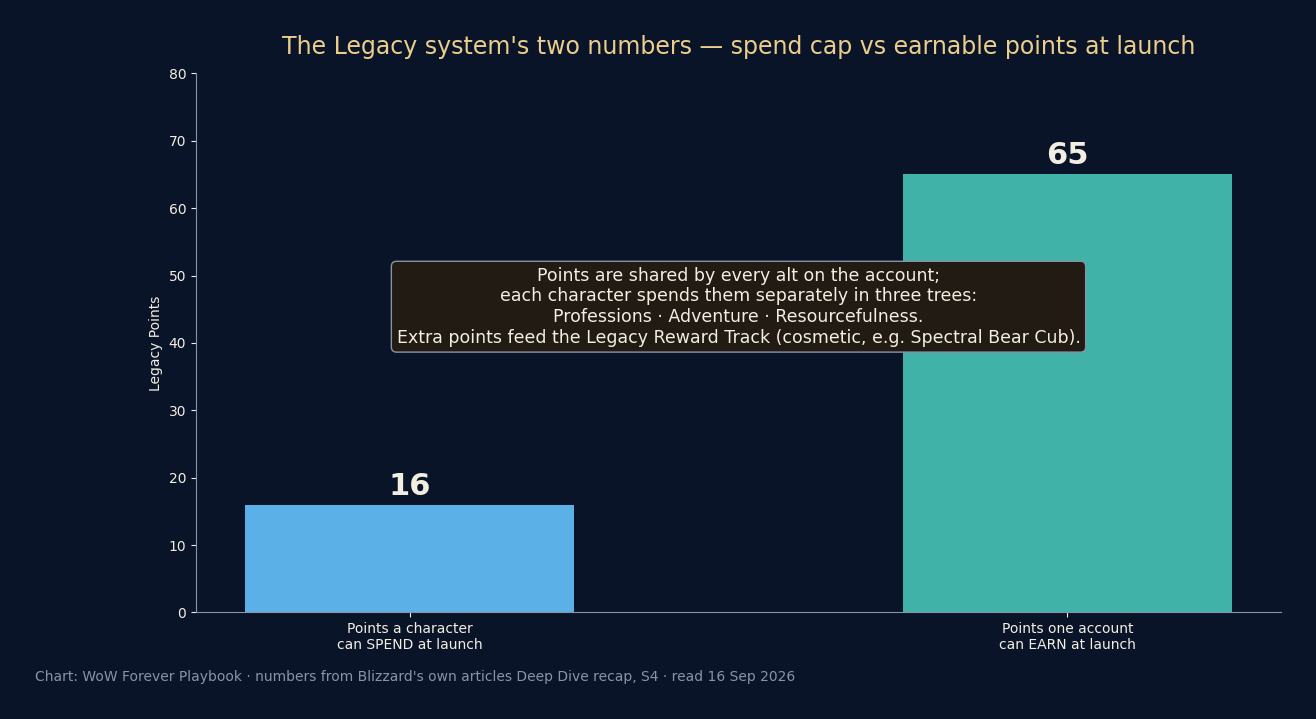
The two numbers: 16 to spend, 65 to earn
'At launch, each character can spend up to 16 points in their Legacy Trees. The cap is intended to keep players from feeling pressured to do everything at once and to help new players avoid feeling too far behind. Players can still continue completing challenges beyond that spending limit and earn up to 65 Legacy Points at the start.' So the ceiling is per character (16) while the pool is per account (65), and the 49-point gap between them is what the Reward Track absorbs.
Blizzard does not say how many points a single challenge awards, how many challenges exist, or how quickly 16 points can be reached. It does say the cap will move: 'expanded spending caps' are on the growth list.
| Figure | Value | Scope |
|---|---|---|
| Spend cap at launch | 16 points | per character |
| Earnable at start | up to 65 points | per account (shared across alts) |
| Trees at launch | 3 — Professions, Adventure, Resourcefulness | per character spending |
| Reward Track | cosmetic / prestige only | per account |
| Points per challenge | not published | — |
| Number of challenges | not published | — |
Shared points, separate spending: how alts interact
'What makes the system especially flexible is that Legacy Points are shared across all alts, while each character spends those points separately in their own trees.' Blizzard describes two player types the design serves: 'Players who want to create many alts can earn points across a wider selection of legacy challenges, taking on new goals such as leveling a different class, while players who want to focus on maximizing a particular character can dive deeper into the categories and complete more complex challenges. Players can also do both.'
One consequence Blizzard spells out for the realmless system: 'Collections and Legacy Points remain account-wide across rulesets, with Hardcore as the exception. Progress, collections, and rewards earned in Hardcore can become available in other rulesets, but progress from other rulesets will not flow back into Hardcore.' A Normal-ruleset alt and a PvP-ruleset alt share Legacy Points; a Hardcore character earns for the account but receives nothing from it.
The three trees and the talents Blizzard named
Adventure: 'the Well Rested talent to increase rested experience gains and raise the rested experience cap, making it especially useful for leveling alts'. Professions: 'the legacy talent Bountiful Harvest to increase the materials gathered from mining, herbalism, or skinning'. Resourcefulness: 'deeper in Resourcefulness, powerful perks such as Reagent Economy can remove reagent requirements from class abilities, making buffing easier while still asking players to make meaningful choices about where to spend their limited points'. Those three are the only named talents. The phrase 'deeper in' implies tiers within a tree, and 'new columns within existing trees' on the growth list implies a column layout; neither the tier structure nor the column count is published.
Read together, the three examples describe the system's intent: Adventure speeds the journey, Professions feeds camping and crafting, Resourcefulness removes Classic friction (reagents) at a cost in scarce points.
| Tree | Talent | Effect (Blizzard's words) |
|---|---|---|
| Adventure | Well Rested | increase rested experience gains and raise the rested experience cap |
| Professions | Bountiful Harvest | increase the materials gathered from mining, herbalism, or skinning |
| Resourcefulness | Reagent Economy | remove reagent requirements from class abilities |
The Reward Track and the mount change that came with it
Points beyond the spend cap 'contribute to the Legacy Reward Track, where accumulating points over time unlocks special cosmetic or prestige rewards, such as the Spectral Bear Cub, without providing a competitive gameplay advantage'. The Spectral Bear Cub is the one named reward; whether it is a pet or a mount is not stated (the name suggests a pet).
In the same paragraph Blizzard announces a mount-economy change that is not strictly Legacy but sits beside it: 'World of Warcraft: Forever is also adopting the Burning Crusade-style mount-cost approach, shifting the up-front mount cost into training and granting a mount when players learn the riding skill.' In Classic the mount and the riding skill were separate purchases; in Forever, learning riding grants a mount. The Skyborne packs' Cerulean Prideclaw still requires the riding skill to be bought in-game, per Blizzard's own pack note.
Legacy against the systems it touches: camping, professions, transmog, realmless
The Legacy trees do not stand alone; two of the three are named after other Forever systems. The Professions tree's Bountiful Harvest raises gathering yields, and gathered materials are what campsite objects and the '600 new recipes' consume; the Adventure tree's Well Rested speeds exactly the alt journey that camping was designed to make social; the Resourcefulness tree's Reagent Economy removes the reagent cost of the class buffs that campsite objects mimic. Transmog appearance collection is account-wide too, and Blizzard puts the two together in one rule: 'Collections and Legacy Points remain account-wide across rulesets, with Hardcore as the exception.'
That rule is the practical one for anyone planning characters across rulesets. A Normal-ruleset main and a PvP-ruleset alt draw from the same Legacy pool and the same appearance collection. A Hardcore character contributes to both pools but draws from neither, and if it dies it 'can transfer to another ruleset, including PvP', carrying its accomplishments with it.
- Professions tree ↔ camping objects and recipes (materials).
- Adventure tree ↔ alts and rested XP.
- Resourcefulness tree ↔ class buff reagents.
- Account-wide across Normal / PvP / Roleplaying; Hardcore contributes but does not receive.
Where the system came from
Blizzard traces Legacy to Hardcore — the ruleset where death is permanent and re-rolling is constant — and describes it as a way to keep 'the world feel active' without Hardcore's stakes. It is also the engine behind two other Forever decisions: the six new race/class combinations ('a reason to experience the journey from a new perspective') and the starting-zone additions ('NPCs, quests, profession hooks, recipes, and small moments'). A Legacy Challenge to level a Dwarf Shaman through a refreshed Dun Morogh is the system in miniature.
Whether players want to build an army of alts, focus deeply on one character, or discover a new path through Azeroth each time, the system is meant to keep the journey feeling rewarding long after the first trip to maximum level.
— Blizzard, World of Warcraft: Forever Deep Dive panel recap, September 2026
What is not published
The challenge list; points per challenge; the full talent list per tree; tree layout (tiers, columns, prerequisites); whether points can be respent; whether the 16-point cap rises with the December content; how the Reward Track thresholds are set; whether any Legacy effect is disabled in the PvP ruleset or in instances. Blizzard's growth list — 'new challenges, new perks, additional ways to spend points, expanded spending caps, new columns within existing trees, and potentially entirely new trees' — is a promise about direction, not a schedule.
- Challenge list and point values — not published.
- Full talent lists and tree layouts — not published (three talents named).
- Respec rules — not published.
- Cap increases — promised ('expanded spending caps'), undated.
- Reward Track thresholds — not published (one reward named).
How to think about your first 16 points
Without the talent lists no build can be recommended, but Blizzard's examples suggest the trade-off it wants you to feel: Well Rested for a player rolling several alts, Bountiful Harvest for a gatherer feeding campsites and the auction house, Reagent Economy for a buffer who hates carrying Symbols of Kings. 'While still asking players to make meaningful choices about where to spend their limited points' is the design line; sixteen is meant to be few.
Questions people ask
- What is the Legacy system in WoW Forever?
- An account-wide progression system: Legacy Challenges (such as leveling a specific class) earn Legacy Points shared across all alts; each character spends them separately in three trees; surplus points unlock cosmetic rewards on a Reward Track.
- How many Legacy Points can I spend?
- Up to 16 per character at launch; the cap is meant to grow.
- How many can I earn?
- Up to 65 at the start, per account.
- What are the three trees?
- Professions, Adventure and Resourcefulness — with more trees 'potentially' later.
- Does Legacy give a gameplay advantage?
- The trees do (rested XP, gathering yield, reagent removal); the Reward Track does not — Blizzard says its rewards come 'without providing a competitive gameplay advantage'.
- Do Legacy Points work in Hardcore?
- Hardcore earns points for the account, but points from other rulesets do not flow into Hardcore.
- Can I buy Legacy Points?
- Nothing of the kind is mentioned; they come from challenges.
- What is the Spectral Bear Cub?
- The one named Reward Track reward. Blizzard does not say whether it is a pet or a mount.
- Will the 16-point cap increase?
- Blizzard lists 'expanded spending caps' among the ways the system will grow, without a date.
- Is there a Legacy challenge for each new race-class combination?
- Challenges include 'leveling a specific class'; the specific list is not published.
Sources & further reading
- Blizzard — World of Warcraft: Forever Deep Dive panel recap (camping, professions, Legacy, realmless, transmog, combat, itemization, races, talents, Paladin), read 16 Sep 2026
- Blizzard — World of Warcraft: Forever What's Next panel recap (zones, dungeons, raids, battleground, roadmap), read 16 Sep 2026
- Blizzard — 'Carve a New Path with World of Warcraft: Forever' (launch date, beta date, edition contents), read 16 Sep 2026
Read next
- WoW Forever guide
WoW Forever guide to every announced system: Legacy points and trees, camping, realmless rulesets, opt-in transmog, 600+ profession recipes and itemization.
- WoW Forever professions
WoW Forever professions: 600+ new recipes, campsite objects and Blueprints, food that grants XP, and the Legacy perks tied to crafting — from Blizzard's recap.
- WoW Forever camping
WoW Forever camping from Blizzard's Deep Dive: the Basic Campfire, three crafted objects, one-hour buffs after /sit, Blueprints and 5/10-object campfires.
- WoW Forever realmless rulesets
WoW Forever realmless explained: Normal, PvP, Roleplaying and Hardcore rulesets replace realms; two-part names unique per region; name reservation 27 Oct–3 Nov.
- WoW Forever race class combinations
WoW Forever race class combinations: the six new pairings (Gnome Priest, Human Hunter, Dwarf Shaman, Orc Mage, Troll Warlock, Undead Paladin) and the Skyborne.
- WoW Forever itemization
WoW Forever itemization from the Deep Dive: merged hit and crit, healing that also hits, situational trinkets, quest rewards and blue dungeon uniques — sourced.
Part of WoW Forever guide. Back to the WoW Forever Playbook home page.

Sukie · Editor
Sukie runs WoW Forever Playbook. She reads every Blizzard article, panel recap and forum post about World of Warcraft: Forever, checks each number against the source before it goes on a page, and rewrites anything a later Blizzard post contradicts. The focus is narrow on purpose: what Blizzard has actually said, with the source attached.
About this site · How pages are checked · Last updated September 16, 2026
WoW Forever Playbook is an unofficial fan site. It is not affiliated with, endorsed by or associated with Blizzard Entertainment. Game names, images and trademarks belong to their owners.